Configure integration flows in a web interface with ETL, ELT, CDC and API capabilities in one platform. Connectors, field mapping, processing templates and runtime monitoring work together to reduce repetitive development.

Traditional integration approaches hold back digital transformation
Stacking too many open-source frameworks makes the architecture overly complex, killing agility, driving up maintenance costs and slowing response to business change.
Scheduling built on open-source components lacks full task monitoring — frequent job failures and processing delays undermine timely business decisions.
Hard-to-use tools make pipeline development dependent on specialist engineers; business users can't build efficiently and talent costs stay high.
Weak real-time capture and transmission, no merge/filter/transform on streaming data, frequent data loss — real-time business scenarios can't be supported.
Without complex distribution from warehouse back to business systems, data sits trapped in the warehouse and its value goes unrealized.
As pipelines multiply, maintaining them and their open-source components becomes a burden — failure rates climb and ops teams burn out.
Connect, transform, schedule and monitor in a web interface to reduce repetitive development
Build integration flows through drag and drop in a web interface, with visible field mappings and processing logic.
ETL, ELT, CDC and API in one platform, with database and application connectors, processing components and templates for data pipelines.
Change Data Capture delivers millisecond-level synchronization, powering real-time data warehouses and data lakes.
Publish data services in minutes with low code, monitor API calls, and turn data assets into monetizable services fast.
24/7 monitoring of every data flow with automatic alerts, smart retries and fully traceable run logs.
Automatic quality checks ensure accuracy, completeness and consistency, with anomalous data intercepted and repair suggestions provided.
Sandboxed multi-tenancy, fine-grained access control and audit logs meet enterprise-grade security requirements.
Four models — public SaaS, hybrid cloud, private perpetual license and source-code edition — fit every security and compliance posture.
Configure APIs, field mappings and data-processing flows in one interface.
Manage integration flows in a graphical interface, see how data is transformed and written, and inspect task status through runtime monitoring.
order_idorderNoorder_statusorderStatustotal_amounttotalAmountWhether internal systems or third-party platforms, Qeasy opens data channels fast — no complex development, configuration is connection. How data flows, transforms and succeeds is fully visible, trackable like a shipment.

Management, scheduling and execution nodes deploy in a distributed architecture with dynamic resource scheduling. Traditional ETL still relies on a single center, lacking cross-site disaster recovery and automatic failover — failures interrupt jobs and delay data. Qeasy breaks through this limit:
Deeply integrated GPT builds pipelines intelligently — describe your needs in natural language and AI generates the processing logic, slashing learning and development costs.
Natural-language configuration assistance
Validate generated logic before activation
Automatic quality monitoring ensures accuracy, completeness and consistency
A one-stop integration solution covering collection, processing, distribution and monitoring
A complete learning system helps you master the platform quickly
A beginner-to-advanced video series covering every platform capability to get you productive fast.
Detailed product docs and API references — guides, best practices and FAQs, ready whenever you need them.
Regular live sessions where product experts walk through capabilities and answer questions in real time.
A community of integration engineers sharing experience and pitfalls — learn from the experts.
Processing templates and industry cases for e-commerce, manufacturing and retail, ready to adapt to your business requirements.
Engineer support and troubleshooting, with service hours and response times defined by the project agreement.
Connectivity, processing, scheduling and monitoring share one configuration and runtime
Qeasy's self-developed engine unifies ETL, ELT and CDC and can run on commodity servers or in private environments. Teams maintain connections, jobs and logs in one platform instead of coordinating separate components.
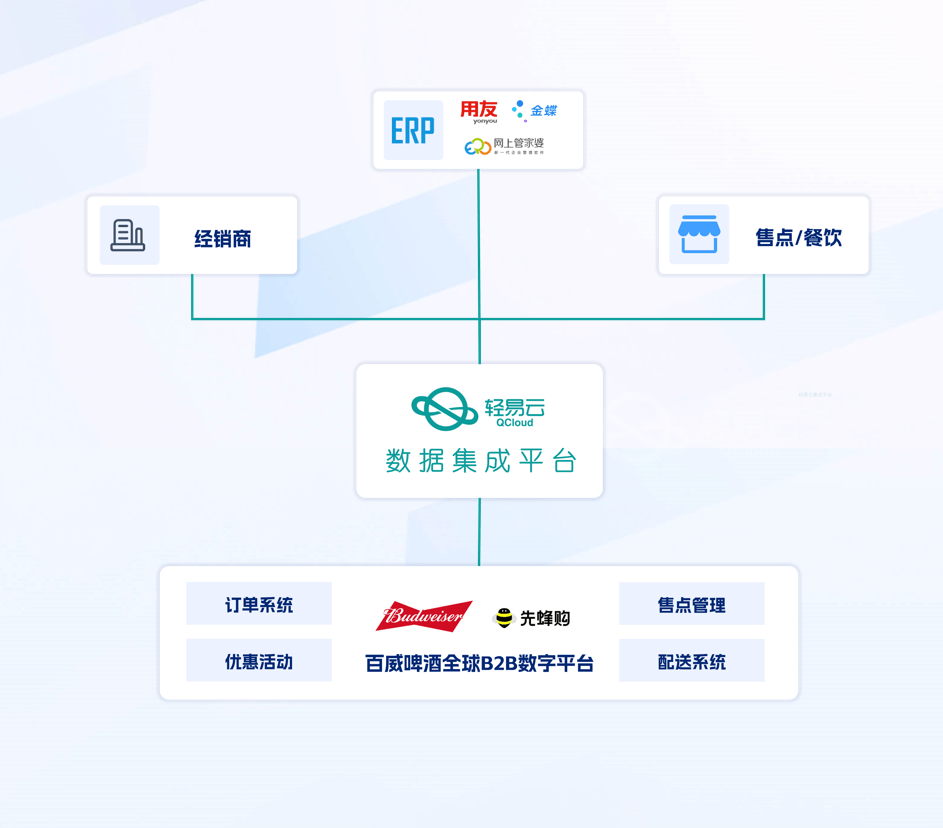
Qeasy supports 100+ databases (MySQL, Oracle, SQL Server, PostgreSQL, MongoDB and more) and 500+ application connectors (Kingdee, Yonyou, SAP, e-commerce platforms, logistics systems and more). Custom systems can also be connected via REST API, JDBC or ODBC.
CDC (Change Data Capture) reads database logs (such as MySQL Binlog and Oracle Redo Log) to capture changes in real time, achieving millisecond-level sync. Incremental, full and hybrid modes ensure timeliness and consistency — ideal for real-time data warehouses.
Yes. Common connections, field mappings and workflows can be configured visually without code, while custom scripts remain available for complex processing. Videos, documentation and training help users get started.
Multiple layers of protection: AES-128 encryption across the entire transmission chain, sandboxed multi-tenant isolation, fine-grained permissions with audit logs, data masking, and full compatibility with domestic compliance requirements.
Yes. Qeasy offers both SaaS and private deployment. Private deployment runs in your own data center or private cloud with distributed multi-node support, meeting the strictest security and performance requirements. Huawei Cloud, Alibaba Cloud and Tencent Cloud are all supported.
Make data integration simple and efficient, and power your digital transformation